The taste of dairy products begins with the health and well-being of the cows. For us, a modern farm does not mean idealized pastures, but sufficient and comfortable space, good-quality feed, ventilation with cooling during the summer, fresh water, and a team dedicated to animal welfare. We are one of the few companies in Romania that controls the entire production chain: from the seed in the soil to the bottle of milk on store shelves. This means we know exactly what the cows eat and what their health status is, every single day.
We are an integrated company, with purpose and responsibility at every stage. We cultivate cereals, oilseed crops, and forage plants on 3,500 hectares—feed that makes up over 90% of our cows’ diet. Our farm, with approximately 2,500 animals, including 1,000 dairy cows, is located right across the road from the dairy factory. That is why the milk reaches the glass bottle in less than 24 hours, without being touched by air or human hands.
But the story of real milk taste does not begin in the factory—it starts much earlier, in the barns, where daily care makes everything possible
The social life of cows: yes, cows have friends
Cows are social animals. Research shows that many cows choose preferred “friends” with whom they spend time, feel calmer, and experience less stress in situations where external stimuli might overwhelm them. When two bonded cows are separated for a long period, their heart rate and milk production can change, and stress-related behaviors occur more frequently.
This phenomenon is called allogrooming—cows exchange a kind of “caress,” a social gesture that helps calm them and maintain harmony within the herd. For them, licking the head and neck areas—where they cannot reach on their own—is a gesture of closeness that reassures them they are safe. On a farm where there is space for such important herd rituals, the animals are simply calmer and more relaxed.
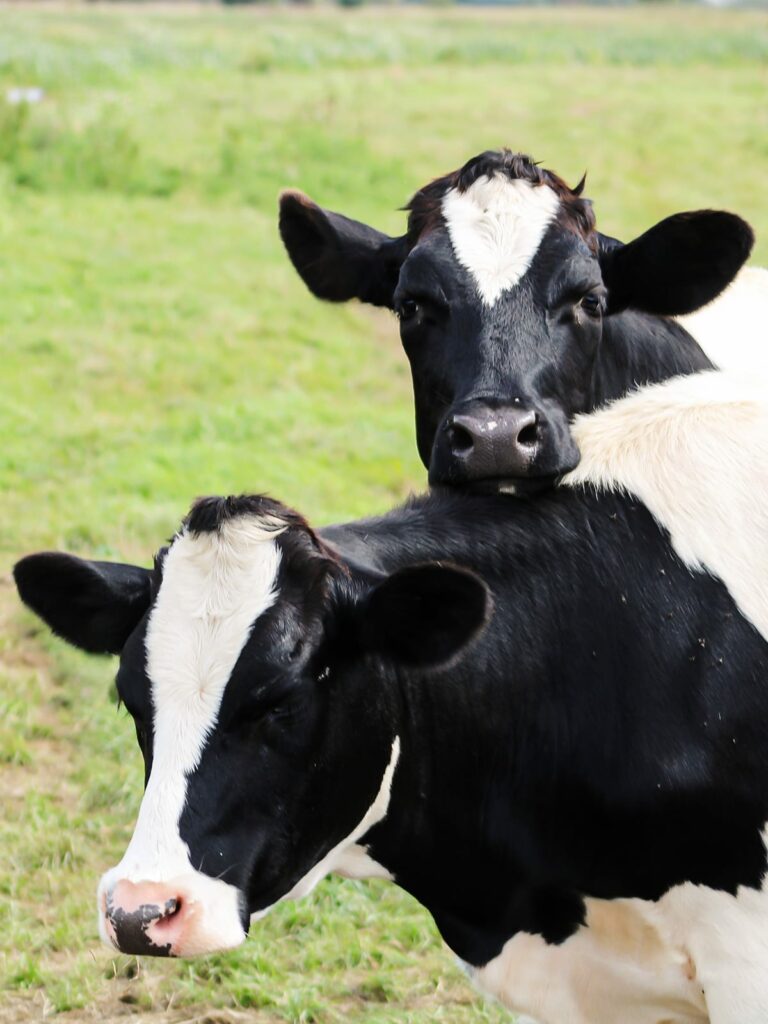
That is why, on our farm, you will not see cows tied up. We raise them in free-stall housing: meaning large, semi-open shelters where they can move around freely, choose where they want to rest and, most importantly, choose who they want to stay close to. Groups are organized so that cows remain near those they feel comfortable with — and this is reflected in their calm behaviour and, indirectly, in the quality of the milk.
How our cows live
It is important for the cows to follow a routine with fixed hours for feeding and milking, with fresh water always available, while still being able to find their own rhythm. Having sufficient space in the semi-open shelter helps them maintain the kind of “social” life mentioned earlier, which has been studied and demonstrated in cattle.
Cows react more poorly to heat than to cold. For them, heat stress can begin at temperatures as low as 22°C (72°F), which means we must ensure continuous air circulation (both naturally and with the help of fans installed in the shelter and cooling sprinklers). We also optimize their summer diet from a nutritional perspective — for example, adjusting sodium and potassium levels, which are easily lost in hot weather. These are just a few of the measures that help us prevent stress, respiratory illnesses, or accidents.
During winter, the shelters protect them from wind and cold, and their feed is optimized for the cold season to provide everything they need.
Hydration, hydration, hydration
Water is the invisible ingredient in milk, and it matters enormously. A dairy cow can drink between 40 and 120 liters of water per day, depending on the season and milk production.
On our farm:
- we have enough water troughs so that no cow has to wait in line;
- water is available 24/7, fresh and in large quantities;
- we clean and check the troughs daily;
- we conduct periodic tests of water quality, both physico-chemical and microbiological.
International animal welfare recommendations confirm exactly these aspects: clean water, easy access, periodic testing, and more watering points than the minimum required.
A personalized diet
A healthy cow needs a balanced diet of fiber, protein, carbohydrates, minerals, and fats. For us, it is simple to control this because we grow almost everything the cows eat ourselves, on our 2,500 hectares of land.
The cows also have nutritionists. Depending on the animal’s age, physiological stage (gestation, lactation), and the season, different categories of animals receive feed perfectly adapted to that stage.
The cows’ team: veterinarians, nutritionists, and caretakers
A good farm is reflected in the care provided by its people, not only in advanced technologies (although those also play an important — and truly significant — role). On our farm, a team of veterinarians and veterinary technicians works alongside nutritionists and trained animal caretakers who maintain a calm routine and are well able to recognize the signs that an animal needs extra attention.
Animal care must be constant, every single day of the year. It consists of small, repeated actions that maintain both the cows’ health and their peace of mind. A simple example: hooves. Because they grow continuously, we schedule at least two trimming sessions per year, and if we notice even a small change in the way a cow walks, we intervene quickly.
We also use special footbaths to prevent dermatitis, one of the most common problems among cattle. These are essential routines that may not be visible in the dairy products themselves, but they are reflected in the cows’ well-being and health.
We are equally attentive to medical monitoring. We periodically conduct blood tests, assess body condition, track all general health indicators, and observe the animals’ behavior. At any sign of change, we know further investigation is needed. Vaccinations are kept up to date according to protocol, because prevention is always gentler than treatment.
All this effort from our teams would be incomplete without a clean and safe environment. Bedding is refreshed daily, animals undergoing treatment are housed separately, and floors are non-slip to prevent injuries.
The truth is simple: a well-cared-for cow produces good milk — and for us, attention to animal welfare is essential.
Why all this matters to you
Good milk production does not begin in the factory — it begins in the field and then on the farm. In the way the cows breathe, the way they eat, the way they sleep, and the way they stay close to their “friends” in the herd.
For us, this means real dairy products, and the taste of milk is the way nature tells its story, season after season. In winter, milk develops a rounder, calmer flavor, with richer, fuller notes. In summer, with higher temperatures and the additional effort made by the cow’s body, natural changes occur in aromatic compounds: the milk may seem lighter, with a subtle sweetness, perhaps even slightly fruity notes.
For these reasons, at Lăptăria cu Caimac, we do not standardize either the taste or the fat content of our milk — we respect them. The quality of our milk is the result of daily choices made by dedicated people. Simple, honest, and transparent choices that speak both of our care for the land we cultivate and of the dedication with which we care for our cows.